


Prem Singh
“The greatest revolution of our time is, therefore, a procedural revolution, removal of injustice through a mode of action characterised by justice. The question here is not so much the contents of justice as the mode to achieve it. Constitutional and orderly processes are often not enough. They are then transgressed by the use of weapons. In order that this should not happen and that man should not ever get thrown around between ballet and bullet, this procedural revolution of civil disobedience has emerged. At the head of all revolutions of our time stands this revolution of satyagraha against weapons although it has in actual effect made only a faltering appearance to date.” – Dr. Rammanohar Lohia, Marx Gandhi and Socialism
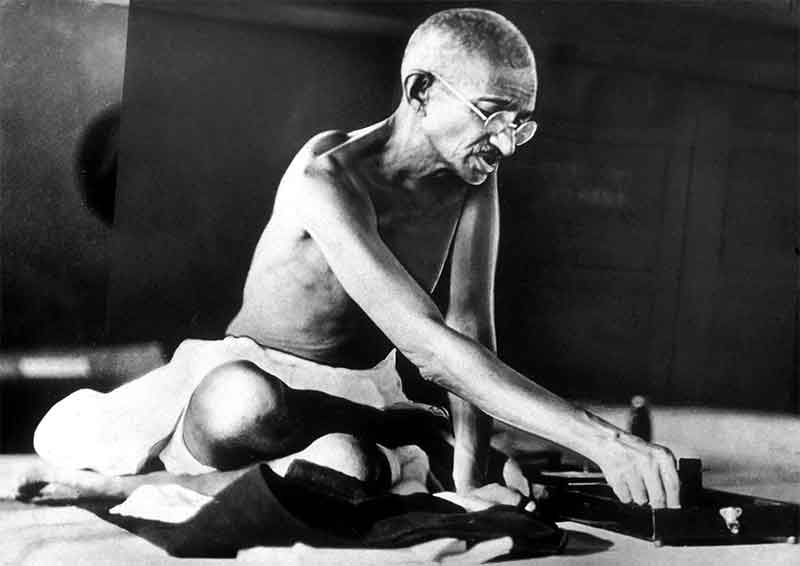
MK Gandhi, who lived a rich life defined by thought and action, has been reduced to a mere photograph and an object of veneration. The contention now centers on who waves Gandhi’s picture more vigorously and who displays greater reverence towards him. (There has been no dearth of individuals or groups in the country who repeatedly fire shots at Gandhi’s photograph and revile him in order to murder him again and again. But that is a separate matter.) In such a milieu, it is pertinent to recall Lohia’s serious endeavor to harness Gandhi’s ideas and mode of resistance for the creation of a new socialist doctrine – one that provides an alternative to the capitalist and communist systems. Both Gandhi and Lohia share a connection with the month of October – Gandhi’s Jayanti falls on October 2nd, while Lohia’s death anniversary is observed on October 12th.
Lohia’s critique of Gandhi has been a significant contribution to the Gandhian studies in the post Gandhi-era. Lohia, as a heretic Gandhian, makes perhaps the most revolutionary interpretation of Gandhi’s philosophy and his unprecedented non-violent mode of protest. After a critical examination of capitalism and communism Lohia finds the whole world in their grip resulting in poverty, war and fear. He proposes the third idea of socialism as an alternative which proceeds by placing the colonized part of the world at the center. He accepts the fact that the idea is not fully elaborated but it is open. According to him, “In an open system there is still some chance of truth and progress, while a closed system does violence to facts and wishes them away in order to prove their meaninglessness.”
Lohia takes fresh initiatives for the construction of a new kind of socialist philosophy and politics much before the Neo-Marxists and the New Left ponder upon the idea. He finds more useful material in the ideas and mode of protest of Gandhi in this venture. According to him the new socialist doctrine would be the basis of a new socialist order in the world which will ultimately lead humanity into a new civilization free from violence and poverty.
Lohia accepts the place of Marx in his tradition but at the same time he clarifies that “…this talk of being a Marxist or an anti-Marxist is futile and irrelevant. What is relevant is correct thinking and integrated approach. Our mind must be on a quest, a quest for the essence that lies under Gandhiji’s or Marx’s thoughts. Quest and not entanglement with tradition can help us to do this.” Lohia refutes a prevalent belief that he tries to mix Gandhi and Marx: “Socialism need not proclaim itself as Gandhian or Marxist on the one hand and as anti-Gandhian or anti-Marxist on the other…”
He further suggests, “… it is not the fault of Marx that people stay put at Marxism.” Lohia criticizes the claimants of Gandhism as well: “It will be countered that what prevails in the country today is not the Gandhi doctrine but a somewhat inferior brew of Gandhism and Marxism. That is substantially correct, but it confirms the weakness of Gandhism in so far as Marxism forces it to mix and also that the best in it is unable to burst forth.”
Lohia wants to apply a filter of Gandhism while theorizing and interpreting the new idea of socialism. Therefore, he does not reject Gandhi’s ideas on truth, time, history, progress, development and even religion. For example, the echo of Gandhi’s cyclic vision of universe and civilization can be heard in Lohia’s cyclic view of history. In the modern industrial civilization the linear view of the driving forces of history has come to be accepted as the gospel truth. Gandhi and Lohia both refuse outright to ride the chariot of that ‘history’ which races ahead only for a small section of the world’s population while demeaning others; and destructing the environment.
In comparison to Gandhi though Lohia gives more importance to the driving force of history, yet he also placed equal significance on the universal values inherent in epics, myths and symbols situated beyond the boundaries of history.
Lohia develops Gandhian sociology in terms of its analysis of the relationship between the caste system and capitalism. Lohia understands that in India capitalism and its positive aspects were hijacked by upper castes, and they have made it a project of caste elites. Lohia’s entire political economy can be treated as an imaginative restatement of Hind Swaraj. He combines the radical social philosophy of the lower caste radicals with Gandhian economics. Thus, the most important contribution of Lohia to Gandhiana is his critique of the dominant paradigms of development, by using the experience of people of the colonized countries, and, at the same time, the marginalized populations within those countries. In India he identifies them as Dalits, tribals, backwards, women and poor minorities.
Lohia theorizes in general terms the specifics of Gandhi’s ideas, images and actions in support of the socialist system of his dream. For example, for him the message of the spinning wheel is controllable technology/machine, village government and direct democracy. Through the notion of controllable technology he paved the way for building a new form of ecological socialism; village government into a four pillar state – decentralization of economic and political power; value of austerity or simple living into decent standard of living and so on.
There is a clear influence of Gandhi in Lohia’s emphasis on the principle of immediacy where he suggests “the essence and justification of each deed should be embedded in the deed itself. It should not become necessary for man to make prefatory or postscript justifications for his deed whereby misdeeds like lies, deceit and bloodshed might be explained away.” Here Lohia seeks to integrate the politics of immediacy with the larger ethical conduct in politics. Thus, the oppositional content of Gandhi’s ideas and actions that Gandhians had lost was restored by Lohia.
Before plunging into Indian politics Gandhi undertook the task of understanding the conditions in the country. Lohia too agreed with Gandhi on this score: “Conditions must be studied before they can be improved upon. There is often no effort in the human mind to investigate the real conditions but a frequent attempt to advise, exhort, and give moral precepts. One should never identify what is with what ought to be.”
Lohia was also in agreement with the manner in which Gandhi proceeded from the ‘local’ to the ‘universal’. Gandhi, though grounded in India, responded to the whole world/universe. This is a unique feature of Lohia’s thought too that any idea or mode he suggested to revolutionize the Indian mind also held good for the rest of the world.
So far the mode of protest against injustice is concerned Lohia finds Gandhi’s method of civil disobedience (civil nafarmani)/satyagrah that enables an individual to resist injustice/oppression without any support, the greatest revolution of our time against weapons.
This is merely an outline of Lohia’s reading and interpretation of Gandhi. The suggestion here is to show that a vibrant and active Gandhi emerges from the way Lohia appropriated Gandhian ideas and mode of resistance for the making of socialism.
(The writer associated with the socialist movement is a former teacher of Delhi University and a fellow of Indian Institute of Advanced Study, Shimla)